Flat roof solar mounting system (new)!

Flat roof solar mounting system (new)!


In the past, the dimension of solar panel on the market was relatively small, such as 1722*1134*30mm, etc.


With the development of the market, the dimension of the solar panel is getting larger and larger, for example: 2279*1134*35mm. The previous installation method people use clamps to fix and merge the short sides of the solar panel. Many installers found that the distance between triangular is too big ,the panel don't have enough support, if the wind speed higher, the middle part of the solar panel will float up and down (Pic 01) , which will reduce the service life of the solar panels.

Picture(01)


After communicating with our customers, we discovered a new installation method, which is to change the original short-side connection to a long-side connection. This greatly improves the stability of the solar mounting structure and also plays a role in protecting the solar panels.(as shown pic 02)

Picture (02)


This new installation method is affirmed by more and more customers. If you are interesting in the item, don't hesitate to contact to us. Looking forward to providing you with better prices and services.


Email:sales9@landpowersolar.com


Top

The Power of Lithium Battery Revolutionizing Solar Energy Storage

In recent years, the demand for clean and sustainable energy solutions has been on the rise. Solar energy has emerged as one of the most viable options, and with it, the need for efficient and reliable storage solutions has become paramount. This is where lithium batteries come into play. With their impressive features and widespread availability, they have revolutionized the solar energy storage industry.

Harnessing the Sun’s Power with Lithium Batteries

One of the key advantages of lithium batteries is their ability to store large amounts of energy generated by solar panels. With advancements in technology, these batteries have become smaller, lighter, and more powerful than ever before. The result? Increased efficiency and enhanced performance for solar energy systems.

The Benefits of Lithium Batteries in Solar Applications

1. High Energy Density

Lithium batteries have a higher energy density compared to traditional lead-acid batteries. This means they can store more energy in a smaller and lighter package, making them ideal for solar installations where space is limited.

2. Long Lifespan

Lithium batteries outperform other battery chemistries in terms of lifespan. With proper maintenance, they can last for thousands of charging cycles, ensuring a reliable and cost-effective energy storage solution for solar applications.

3. Efficient Charging and Discharging

Lithium batteries offer a high charge and discharge efficiency, allowing for maximum utilization of the stored solar energy. This means you can make the most of your solar system by efficiently storing and utilizing the energy it generates.

4. Rack Design for Optimal Space Utilization

To further optimize space utilization, some lithium battery manufacturers offer rack design options. These innovative battery racks allow for easy installation and scalability, making it convenient to expand your solar energy storage system as needed.

5. Seamless Communication and Control

Modern lithium batteries often include built-in communication systems that enable seamless integration with solar inverters and monitoring equipment. This allows for remote monitoring, control, and optimization of your solar energy storage system, enhancing its overall performance and reliability.

Finding the Right Lithium Battery for Your Solar Storage Needs

When it comes to selecting a lithium battery for your solar storage requirements, it is crucial to partner with a reliable and reputable solar storage battery manufacturer. Their expertise will ensure that you receive a high-quality and well-designed battery system tailored to your specific needs.

Look for a manufacturer that offers a wide range of lithium battery options, including the popular 48V 200Ah lithium battery and 5kWh lithium battery models. They should also provide efficient customer support and after-sales service to guarantee the longevity and optimal performance of your solar energy storage system.

Conclusion

As the demand for solar energy continues to grow, the importance of efficient and reliable storage solutions cannot be overstated. Lithium batteries, with their high energy density, long lifespan, efficient charging and discharging, rack design options, and seamless communication capabilities, are the perfect fit for solar storage applications.

When choosing a lithium battery for your solar energy storage needs, trust a reputable solar lithium-ion battery supplier. With their expertise and extensive product range, you can harness the power of lithium batteries and experience the true potential of solar energy. Embrace the renewable energy revolution with lithium batteries and pave the way for a cleaner and sustainable future.

Top

A Beginner's Guide to Using Industrial 500 Watt Solar Panel Suppliers Price 535-560W

Solar power is an excellent alternative energy source, and investing in solar panels is a smart move towards a more sustainable future. If you’re considering harnessing the power of the sun, you may have come across the Industrial 500 Watt Solar Panel Suppliers Price 535-560W. In this beginner’s guide, we’ll walk you through the step-by-step process of using these solar panels effectively and efficiently.

Step 1: Assess Your Energy Needs

Before purchasing solar panels, it’s crucial to evaluate your energy requirements. Consider the appliances and electronics you use regularly and calculate your daily energy consumption. This assessment will determine the number of solar panels you’ll need to meet your energy goals.

Step 2: Research and Compare Suppliers

To ensure you’re getting the best quality solar panels at a competitive price, research and compare different suppliers. Look for reputable suppliers offering Industrial 500 Watt Solar Panel Suppliers Price 535-560W and read reviews from other customers to gauge their reliability and customer satisfaction.

Step 3: Determine Panel Placement

The placement of your solar panels will directly impact their efficiency. Choose a location where panels receive ample sunlight throughout the day, ideally with minimal shading. South-facing rooftops are often the best option, but ground-mounted installations can also work well if you have the space. Consider any local regulations or homeowner association rules before finalizing the panel placement.

Step 4: Install and Connect Solar Panels

If you’re confident in your DIY skills, installing the solar panels yourself can save you money. However, it’s essential to follow all safety guidelines and instructions provided by the supplier. Ensure that the panels are securely mounted and properly connected to your home’s electrical system.

Step 5: Monitor and Maintain

After the installation, regularly monitor the performance of your solar panels. Keep an eye on their energy production, and if you notice any significant drops, check for possible obstructions or damage. Additionally, schedule periodic inspections and maintenance to ensure your panels remain clean and functioning optimally.

Step 6: Benefit from Solar Power

With your Industrial 500 Watt Solar Panel Suppliers Price 535-560W in place, you can start enjoying the benefits of solar power. Track your energy savings, reduce your carbon footprint, and take pride in being part of the clean energy movement.

Conclusion

Switching to solar power may seem overwhelming at first, but with the right information and guidance, it becomes much simpler. By following this step-by-step guide, you can confidently use Industrial 500 Watt Solar Panel Suppliers Price 535-560W and contribute to a greener and more sustainable future. Embrace the power of solar energy and take control of your electricity consumption.

Top

Step-by-Step Guide How to Use the EU Stock Bifacial Monocrystalline Solar Panel 440 Watt Topcon N Type Solar Panels

Are you new to using solar panels and looking to harness the power of renewable energy? Look no further! In this step-by-step guide, we will walk you through the process of using the EU Stock Bifacial Monocrystalline Solar Panel 440 Watt Topcon N Type Solar Panels. Whether you are a beginner or have some experience, this guide will help you make the most of your solar panel investment.

Step 1: Familiarize Yourself with the Components

Before getting started, familiarize yourself with the different components of the EU Stock Bifacial Monocrystalline Solar Panel 440 Watt Topcon N Type Solar Panels. These include the solar panel itself, junction box, frame, and connectors. Take a moment to understand how they fit together and their functions.

Step 2: Find a Suitable Location

Choose a location for installing your solar panel where it can receive maximum sunlight throughout the day. Ideally, it should be placed in an area free from shade or obstructions. Take into consideration factors such as roof orientation, tilt angle, and the direction of the sun’s path. This will help optimize the energy output of your solar panel.

Step 3: Safety First

Before installing or handling the solar panel, ensure your personal safety. Wear appropriate safety gear such as gloves and safety glasses. If you’re unfamiliar with electrical work, consider seeking professional assistance during the installation process.

Step 4: Mounting the Solar Panel

Securely mount the solar panel on a sturdy surface, such as a roof or a ground-mounted structure. Follow the instructions provided by the manufacturer for proper installation. Ensure that the solar panel is securely fixed and does not move or wobble.

Step 5: Electrical Connections

Connect the solar panel’s junction box to the wiring of your solar system. Properly tighten and secure the connections to avoid any loose wiring. If you are unsure about the wiring, consult a professional electrician.

Step 6: Monitor and Test

Once the installation is complete, monitor the performance of your solar panel regularly. Keep an eye on the energy production levels, and compare them to your expected values. Check for any signs of damage or shading that may affect the panel’s efficiency.

Step 7: Maintenance and Cleaning

To ensure optimal performance, regularly clean the solar panel using a soft cloth and mild detergent. Remove any dirt, leaves, or debris that may accumulate on the surface. Be cautious not to scratch or damage the solar panel while cleaning.

Step 8: Monitor Energy Savings

Track and analyze the energy savings generated by your solar panel system. Keep a record of your electricity bills to compare with previous years. This will help you understand the positive effects of using solar energy and determine your return on investment.

Congratulations! By following this step-by-step guide, you have successfully learned how to use the EU Stock Bifacial Monocrystalline Solar Panel 440 Watt Topcon N Type Solar Panels. Enjoy the benefits of green energy and contribute to a sustainable future.

Remember, if you encounter any difficulties or concerns during the process, it’s always a good idea to consult the manufacturer’s documentation or seek professional guidance.

Top

0BB Technology A Disruptive Innovation in the Photovoltaic Industry

In the photovoltaic (PV) industry, "0BB" (Busbar-less) technology is sparking a revolution. BB stands for “Busbar,” which refers to the main grid lines on PV cells, with the preceding number indicating the quantity of busbars. Over the past decade, PV technology experts have diligently increased the number of busbars from 2 to 20. However, this trend is now undergoing a significant reversal, with industry leaders heavily investing in the research and development of 0BB technology.


Evolution of Busbar Technology

PV cells convert sunlight into electricity through the photovoltaic effect, and this current needs to be collected and transmitted via grid lines made of silver. These grid lines include main and fine grid lines. The current travels from fine grid lines to the main grid lines and is then transmitted to the solder strips. Increasing the number of busbars brought several benefits, such as reducing the use of silver paste, lowering costs, and decreasing power loss. Consequently, multi-busbar (MBB) and super multi-busbar (SMBB) technologies have become mainstream.

However, as research progressed, companies began exploring the possibility of completely removing the busbars. The 0BB technology aims to simplify the current transmission path by eliminating the main busbars, allowing fine grid lines to connect directly to the solder strips through welding points. This concept has gradually gained traction and attracted widespread attention in the PV industry.


Rise and Advantages of 0BB Technology

Compared to existing SMBB technology, 0BB technology offers several key advantages:


Power Enhancement

0BB technology removes the busbars, reducing the shading area on the cell surface and increasing power generation. Additionally, the dense distribution of welding points on the cell shortens the current transmission path within the fine grid lines, further reducing power loss. For instance, incorporating 0BB technology with ABC high conversion efficiency advantages can increase the overall power of products by 5W.


Cost Reduction

Traditional grid lines made of silver paste account for the highest proportion of non-silicon costs in PV cells. With rising silver prices, reducing the use of silver paste is crucial for cost reduction. 0BB technology eliminates the busbars, potentially reducing silver paste consumption by 20%-40%, significantly lowering PV cell costs. Research indicates that applying 0BB technology can reduce the cost of silver paste to 1-6 cents/W for various technologies.


Higher Quality

The smaller and more numerous welding points in 0BB technology result in a more uniform stress distribution, reducing the rate of cell fractures, grid line breaks, and micro-cracks, thereby improving production yield. Furthermore, the uniform stress distribution allows for the use of thinner silicon wafers, with the thinnest possible being 100μm.


Industry Giants' Adoption

In recent years, leading PV companies such as Trina Solar, Tongwei Co., JinkoSolar, Chint New Energy, Canadian Solar, Risen Energy, and Aiko Solar have ramped up their research efforts in 0BB technology, placing high hopes on its potential. For instance, JinkoSolar has completed preliminary tests of 0BB technology, demonstrating significant power and cost improvements. Risen Energy and Huasheng New Energy have also released 0BB heterojunction modules, showcasing the practical application potential of 0BB technology.


Ongoing Challenges and Innovations

Despite its promising future, 0BB technology faces several challenges, including ensuring welding consistency and testing efficiency. Particularly, the reliability issues arising from welding silver and copper, which have different chemical and physical properties, pose a challenge. These materials tend to separate under external force or thermal expansion, affecting the PV cell's performance.

Some companies have proposed solutions to these challenges. For example, by innovating with “silver-free metal coating technology,” using copper to make fine grid lines and welding points, they have addressed the reliability issue. This technology significantly improves welding strength and enhances cell stability.


Conclusion

0BB technology brings significant cost reductions and efficiency improvements, making it a focal point in the next wave of technological competition. Despite facing challenges, continuous innovation and improvements in 0BB technology will play an increasingly vital role in the PV industry. Moving forward, 0BB technology will continue to drive the development of the PV sector, laying the foundation for more efficient and economical solar energy utilization.

Top

Advancing Photovoltaics A Continuous Journey Towards Efficiency

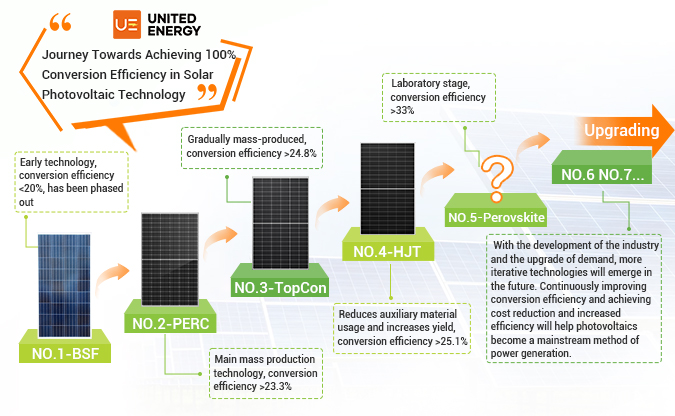
In the pursuit of cleaner and more sustainable energy, the photovoltaic (PV) industry is undergoing a transformative revolution aimed at achieving higher conversion efficiency. While the goal of 100% conversion remains distant, each technological advancement brings us closer to it. Short- and medium-term breakthroughs lay the groundwork for long-term progress. The era of new energy has arrived. Photovoltaics now power countless households, providing clean, affordable, and sustainable green energy, benefiting our planet.

 Advancing Photovoltaics: A Continuous Journey Towards Efficiency

Legacy and Evolution: BSF Cells


Back Surface Field (BSF) technology, one of the earliest in polycrystalline black silicon cells, suffers significant photovoltaic loss due to infrared reflection, resulting in less than 20% conversion efficiency. As the market shifts towards more efficient alternatives, BSF technology gradually fades.


Current Leader: PERC Cells


Passivated Emitter and Rear Cell (PERC) technology dominates large-scale production in the solar industry, achieving a significant leap with a 23.3% conversion efficiency in 2023. Their silicon dioxide passivation layer enhances sunlight absorption, thereby improving efficiency. Compatible with high-efficiency cell technologies, PERC cells serve as a platform for further development.


Emerging Advantages: TopCon Cells


Tunnel Oxide Passivated Contact (TopCon) cells, the new favorite in the industry, achieved a 25% conversion efficiency in 2023, offering about a 1.5% efficiency improvement over their p-type counterparts. Gradually replacing PERC cells to become the industry's mainstay.


Next-Generation Potential: HJT


Heterojunction Technology (HJT) cells offer an additional 0.2-0.3% efficiency improvement over TopCon. Additionally, they increase production efficiency by 2% in mass production while reducing consumption of auxiliary materials like silver paste, crucial for cost reduction.


Bright Future: Perovskite Cells


Perovskite cells, though still in the experimental stage, promise to redefine PV efficiency standards. Demonstrating efficiencies between 30-40%, surpassing silicon-based technologies, they offer the advantage of shorter production cycles, although the feasibility of large-scale production remains to be determined.


As the PV industry innovates to meet demand, the emergence of more iterative technologies will shape the future. The relentless pursuit of higher conversion efficiency, alongside cost reduction imperatives, positions PV as a mainstream power source. The progress in solar technology is not just a story of scientific breakthroughs; it's a narrative of continuous transformation and relentless upgrading, with each chapter bringing us closer to a cleaner, more sustainable energy future.

United Energy Co.,Ltd
Add:No. 389-399, Jinzhai Road, Luyang District, Hefei City, Anhui Province
Mobile/Whatsapp/Wechat: +86 189 0569 0996
Email: info@ue-pv.com Web: www.unitedpvsolar.com

Top

Empowering Energy Storage The Transformation and Future of Modern Distribution Networks

The distribution network is the final link in the power system, traditionally responsible for distributing electrical energy. However, with the widespread integration of distributed renewable energy sources, the emergence of diverse loads such as electric vehicles, and the advancement of the electricity market, the operating model of the distribution network is undergoing profound changes. It is evolving from a traditional endpoint distribution network to a modern distribution network capable of source-grid-load-storage interaction. This transformation is not only reflected in the changes in power flow patterns but also in the integration of power flow, information flow, and business flow.


Changes in Distribution Network Operation


Impact of Distributed Renewable Energy

The rapid development of distributed photovoltaics (PV) has significantly altered the traditional operating patterns of the power system. Firstly, with the increased penetration of distributed PV, a substantial amount of electrical energy is being fed back into the grid, causing reverse overloads in local areas, low-voltage lines, and even main transformers at system substations. Secondly, the development of distributed PV and controllable loads such as charging stations has changed the load characteristics of the power system, increasing the volatility, intermittency, and randomness of renewable energy generation. These changes significantly heighten the difficulty of grid regulation. Lastly, the extensive use of distributed PV, charging stations, and frequency conversion equipment presents higher demands on the power quality and safe, stable operation of the distribution network.


The Role of Energy Storage in Regulation and Support

Energy storage, as a crucial regulatory resource, plays a key role in the adjustment and support of the distribution network. It is a major component for adapting to the new forms of distribution networks. Specifically, energy storage plays an important role in the following areas:


Addressing the Challenges of Distributed Renewable Energy Integration

1. Industrial and Commercial User-Side Energy Storage: Utilizing the peak-shaving and valley-filling capabilities.

2. Distributed Energy Storage at Distribution Network Nodes: Integrating energy storage at local substations and switching stations.

3. Grid-Side Energy Storage: Installing energy storage at substations in load centers.

4. New Business Models: Exploring microgrids and integrated photovoltaic-storage systems to facilitate the efficient local absorption of distributed renewable energy, thus reducing the impact on the distribution network.


Enhancing the Adjustability and Flexibility of the Distribution Network

With the integration of distributed renewable energy and controllable loads like charging stations, the demand for regulation within the distribution network has surged, and the volatility of loads over both short and long periods has increased. Energy storage, with its flexible regulation capabilities, can achieve friendly interaction and efficient operation between sources, grids, loads, and storage. In regions with tight power supply capacities, constructing integrated solar-storage-charging projects can ensure that charging stations charge the storage system when idle and discharge stored energy to fill gaps when charging electric vehicles. Additionally, as electric vehicles become more prevalent, they can play a regulatory role in the distribution network through Vehicle-to-Grid (V2G) technology.


Providing Operational Reliability for the Distribution Network

Energy storage systems have millisecond-level rapid response capabilities, providing quick support during voltage and frequency drops in the distribution network, thus enhancing the reliability of power supply. Furthermore, energy storage can operate in voltage source mode and support transient stability, strengthening the robustness of the distribution network.


Participating in the Electricity Market and Providing Ancillary Services

With the progression of the electricity market and the gradual establishment of market and profit mechanisms, future user-side energy storage systems can, under suitable measurement and dispatch conditions, participate independently in the electricity market. They can also offer ancillary services such as peak shaving, frequency regulation, and voltage regulation through virtual power plants, thereby supporting the distribution network.


Future Development of Distribution Networks

Energy storage is a key technology for achieving the flexible, intelligent, and digital transformation of distribution networks. By integrating with large-scale distributed renewable energy sources and controllable loads such as charging stations, a distribution network capable of source-grid-load-storage interaction can be built. This will effectively promote the absorption of renewable energy and the efficient allocation of resources. This integration not only improves the overall efficiency and reliability of the power system but also lays a solid foundation for optimizing future energy structures and ensuring the healthy development of the electricity market.


In conclusion, the distribution network is transitioning from a traditional power distribution role to a modern, multifunctional power system hub. The application of energy storage technology will play an indispensable role in this transformation, driving the distribution network towards a more intelligent, efficient, and sustainable future.

Top

Explosive growth of TOPCon production capacity accelerates P/N technology iteration

2022 is regarded as the first year for the development of N-type battery technology. According to statistics, by the end of 22, TOPCon and HJT’s landed production capacity reached 81GW and 13GW respectively. Considering that there are still about 1GW of xBC shipments in the market, the total shipment of N-type modules has reached about 20GW in 2022, and the proportion of total shipments of N-type modules has reached about 7%.


Among N-type technologies, TOPCon has proven that it has comparable or even better profitability than PERC. During the P-to-N technology iteration window period, traditional photovoltaic manufacturers have aggressively expanded their production capacity to consolidate their market positions. New entrants also hope that Relying on the advantages of no historical burden, the rapid production capacity layout can establish its own market share. As of February 23, it announced that the production capacity of high-efficiency battery technology has exceeded 1100GW, of which more than 850GW of new production capacity chooses TOPCon technology.


TOPCon Development Status


According to InfoLink statistics, the nominal production capacity of TOPCon is expected to reach 477GW by the end of 23, which means that the production capacity of TOPCon batteries by the end of 2023 will be equivalent to the existing PERC battery production capacity. In 2022, only Jinko has a 10GW TOPCon production capacity, but by the end of 2023, more than 17 manufacturers will have a 10GW and above production capacity. In addition, new entrants will also contribute more than 50GW of TOPCon production capacity in 2023.


In terms of efficiency, mainstream TOPCon battery manufacturers all claim that the efficiency is around 25.0%, and further gains of 0.2-0.3% can still be achieved by superimposing SE technology in the future. Look, the real efficiency is still around 24.2%, which is about 1% higher than the efficiency of PERC cells.


In terms of yield rate, the performance of each company is still quite different. Although the leading companies have achieved a level comparable to PERC, the yield rate of most manufacturers is still hovering at 95% or even less than 95%. Cost reduction is the top priority.


In terms of overseas production expansion, Southeast Asia is expected to add 21GW of TOPCon batteries in  2023, and India will also increase 6GW. Among them, TRW's 2GW in Thailand is already in the stage of ramping up its production capacity.


Competition of TOPCon technical route


The TOPCon production capacity in the market in 2023 and before was mainly based on the LPCVD route and the POPAID route dominated by Jolywood. Among them, LPCVD has become the most mainstream technology route because of the largest expansion of Jinko and Jietai. Although the LPCVD route technology is mature and the passivation effect is excellent, the low production capacity and the high cost of quartz parts have prevented the industry from giving up the research on the PECVD route. With the continuous breakthroughs in efficiency and yield of Tongwei and Trina PECVD routes, The potential cost advantage caused by the high production capacity of PECVD has attracted more and more manufacturers to expand production and choose this route.


As of February 2023, InfoLink differentiated based on the 326GW production capacity in production and under construction (equipment bidding completed) according to the Poly deposition route. Among them, the LPCVD route is mainly based on Jinke, Jietai and Longji, accounting for about 42% of the total ; while PECVD is mainly based on Tongwei, Trina, Shangji, Runyang, etc., accounting for about 52%; although the POPAID route has the advantages of fast film forming speed and no winding, the Uptime of plate equipment is relatively low, which leads to the audience Still less. At present, the LPCVD route is trying to upgrade from single-slot and single-insert to single-slot and double-insert to double the production capacity. It is estimated that the competition between the mainstream routes of LPCVD and PECVD will exist for a long time.


Top

From Solar Cells to Solar Module - UE production procedure

The production of photovoltaic modules is a highly sophisticated and complex process, involving multiple stages of automation from the manufacturing of solar cells to the final assembly and testing of solar modules. UE, as a manufacturer, has incorporated advanced technologies and equipment throughout the entire production process to ensure its solar panels exhibit outstanding performance and reliability.
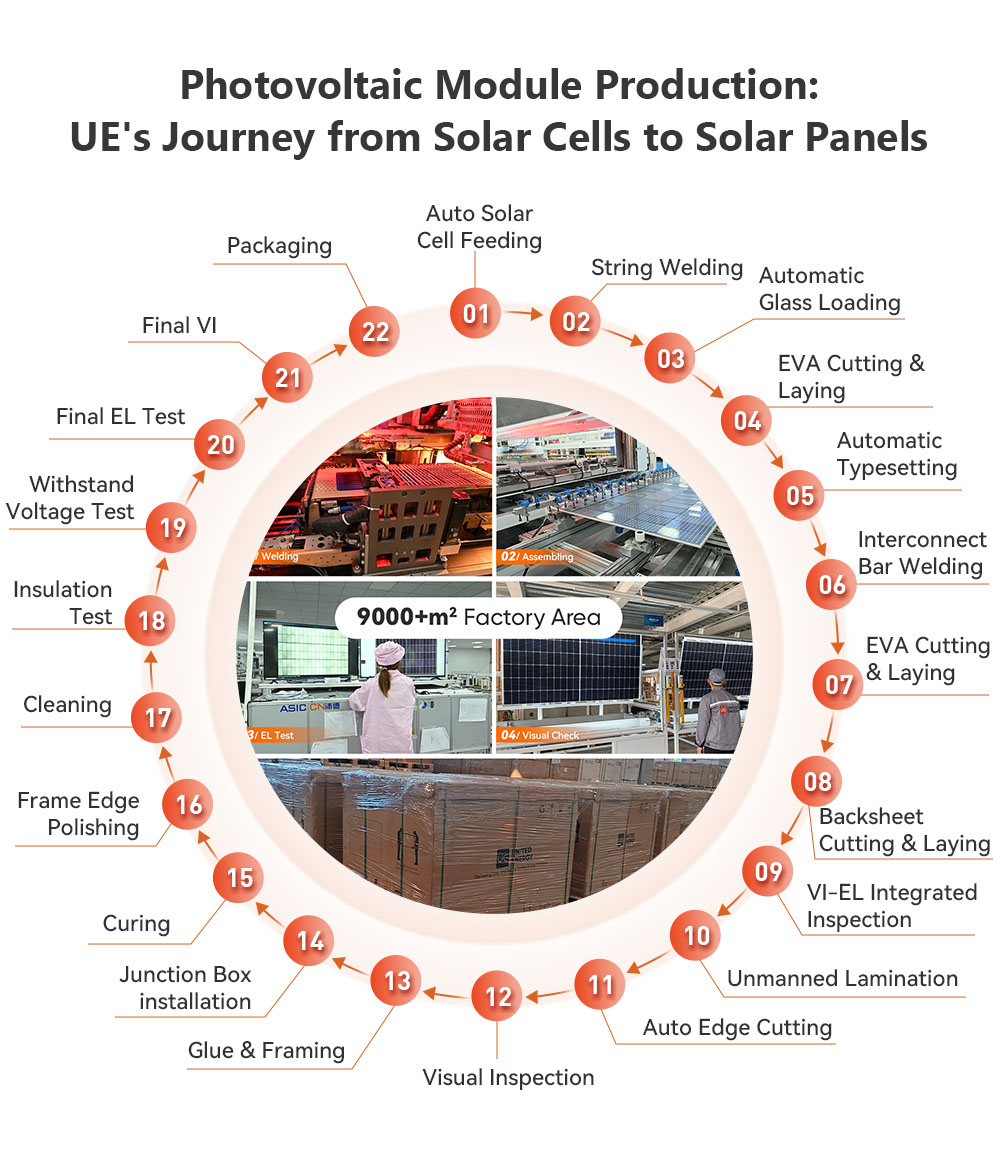
 

UE's Journey from Solar Cells to Solar Panels

1.Auto Solar Cell Feeding 

All solar cells used in UE's production are sourced from top-tier brands such as TW Solar, Longi, and AIKO Solar,this ensures the quality and reliability of the solar cells, laying a solid foundation for subsequent manufacturing stages.


2.String Welding

At this stage, the solar cells undergo automatic slicing and string welding, using a conductive copper strip (tinned copper tape) for the series connection of solar cells. Infrared technology is employed to detect false welding and broken cells automatically, problematic cells are identified and removed from the production process.


3.Automatic Glass Loading 

Transparent glass is automatically loaded as the outer protective layer for PV modules, ensuring each module possesses a robust and transparent exterior.


4.EVA Cutting & Laying 

EVA (Ethylene Vinyl Acetate) is a crucial material used for encapsulating solar cells. Automatic cutting and laying of EVA in the initial stage ensure its precise placement to protect solar cells and enhance light absorption efficiency.


5.Automatic Typesetting 

Solar modules need to be arranged in well-designed positions to ensure optimal performance. Automatic typesetting efficiently arranges solar cell strings, EVA, and other module parts in appropriate positions. String welding rules are defined, such as 10 cells per string for a 60-cell module, 12 cells per string for a 72-cell module, and 13 cells per string for a 78-cell module.This allows UE to produce solar modules from 100W-720W.


6.Interconnect Bar Welding

During this stage, automatic welding is performed between solar cell strings to ensure smooth flow of electric current and maximize the efficiency of the PV panels.


7.EVA Cutting & Laying 

In the second EVA cutting and laying phase, each solar panel is thoroughly encapsulated, providing additional protection and durability.


8.Back-sheet Cutting & Laying 

The back-sheet, serving as the bottom layer of the solar module, is precisely cut and laid to ensure complete coverage and protection of the module's back.


9.VI-EL Integrated Inspection 

Utilizing a VI device similar to a smart camera, this stage involves a comprehensive inspection for missing corners and obstacles within solar cells. Problematic cells are automatically identified and segregated.


10.Unmanned Lamination 

The lamination process involves bonding and fusing solar cells, glass, EVA, and back-sheet together under specific temperature, pressure, and vacuum conditions.


11.Auto Edge Cutting 

Following lamination, excess EVA is trimmed to ensure a neat appearance.


12.Visual Inspection

Through visual inspection using a dual-sided flipping technique, each solar panel is meticulously examined to identify cracks, defects, or other issues affecting performance.


13.Glue & Framing 

At this stage, the automatic gluing and framing process firmly secures all modules together, creating a robust framework. This enhances the stability and durability of the solar modules.


14.Junction Box Installation

The installation of the junction box involves sealing and potting to ensure no exposed metal, achieving a waterproof rating of IP68 and improving the PV module's weather resistance.


15.Curing 

Solar panels are placed in an automatic curing device to ensure the solidification of adhesives and other materials under specific temperature and time conditions, maintaining the stability of their structure.


16.Frame Edge Polishing

Automated edge polishing involves refining and smoothing the edges of the solar module's frame for an enhanced appearance.


17.Cleaning

Cleaning is performed to ensure there is no contamination on the module's surface, maintaining transparency and photovoltaic efficiency.


18.Insulation Test 

Insulation testing ensures there is no leakage, preventing lightning breakdown and potential electric shocks.


19.Withstand Voltage Test 

This test is conducted to verify the solar panel's ability to withstand voltage under normal operating conditions, ensuring safety and reliability.


20.Final EL Test 

A secondary Electroluminescence (EL) test is performed to conduct a final assessment of the solar panel's ultimate performance, ensuring all solar cell strings and modules meet design requirements and function properly.


21.Final VI 

The final visual inspection ensures that the module's appearance, dimensions, and identifiers align with quality standards.


22.Packaging 

Finally, solar panels are carefully packaged to prevent damage during transportation and installation, ensuring they reach customers or end-users in pristine condition.


This comprehensive manufacturing process reflects UE's commitment to producing high-quality solar products. Through advanced manufacturing processes and quality control measures, UE actively contributes to the promotion of clean energy and sustainable development. This production journey not only showcases the integration of technological innovation and efficient production but also demonstrates an unwavering dedication to product quality and reliability.

Choose UE, your trust-worthy PV supplier, delivering Safe and Secure Energy Solutions.
United Energy Co.,Ltd Sales Engineer

United Energy Co.,Ltd
Add:No. 389-399, Jinzhai Road, Luyang District, Hefei City, Anhui Province
Mobile/Whatsapp/Wechat: +86 189 0569 0996
Email: info@ue-pv.com Web: www.unitedpvsolar.com

Top

Introduction to BC Solar Panels

BC solar panels, or Back-Contact solar cells, represent a significant advancement in photovoltaic technology. By relocating the metal grid lines from the front to the back of the cell, BC solar panels reduce sunlight obstruction and enhance conversion efficiency. This innovation offers several benefits, including high conversion efficiency, greater short-circuit current, high fill factor, improved resistance to degradation, and an aesthetically pleasing appearance. Despite their complex manufacturing process and higher costs, BC solar panels hold promising potential in the solar energy market.

BC solar panels


Types of BC Solar Cells

BC solar cells encompass various types, including Interdigitated Back Contact (IBC), Tunnel Oxide Passivated Contact (TBC), Heterojunction with Intrinsic Thin-layer (HBC), and Hybrid Passivated Back Contact (HPBC). Each type combines the basic BC technology with other advancements to optimize performance:

1. IBC Cells: The classic IBC cells feature a design where the emitter and back surface field (BSF) are alternately arranged on the cell's back, minimizing light obstruction and maximizing efficiency. SunPower's Maxeon brand is a leading example, with a production capacity of several gigawatts and significant market share in the U.S.

2. TBC Cells: Combining TOPCon and IBC technologies, TBC cells utilize N-type silicon substrates and offer higher conversion efficiencies. Leading TOPCon companies are preparing to release TBC products, with anticipated power outputs of 600-610 watts.

3. HBC Cells: These cells merge HJT and IBC technologies, using intrinsic amorphous silicon films for passivation, enhancing surface defect reduction while maintaining the unobstructed light absorption advantage of IBC cells.

4. HPBC Cells: Developed by companies like Longi, HPBC cells use P-type silicon substrates, offering a cost-effective solution with impressive efficiency and aesthetic qualities.


Advantages of BC Solar Panels

BC solar panels offer several distinct advantages over traditional solar cells:

1. Enhanced Efficiency: By eliminating front-side grid lines, BC solar panels increase the area available for sunlight absorption, boosting short-circuit current by approximately 7% compared to conventional cells.

2. Flexible and Robust Design: The back-side wiring of BC panels allows for simpler, more flexible encapsulation, improving resistance to micro-cracking and other forms of stress. For instance, Longi's HPBC cells show a 48% reduction in edge stress compared to traditional cells.

3. Aesthetic Appeal: With a uniform, grid-free front surface, BC solar panels offer a more visually appealing solution for residential and commercial installations, making them particularly attractive for high-end distributed markets.


Market Potential and Future Outlook

As PERC cell technology approaches its efficiency limits, the market share for N-type technologies like TOPCon and BC cells is expanding. Currently, BC cells are in the early stages of market adoption but are gaining traction due to their efficiency and distinct advantages. The key challenge for BC technology is reducing production costs. Companies like Aiko Solar aim to achieve cost parity with TOPCon cells by mid-2024, which would significantly enhance the competitiveness of BC panels.

BC solar panels are well-suited for applications where efficiency and aesthetics are paramount, such as in vehicles, ships, satellites, and buildings with limited load-bearing capacity. If manufacturing costs decrease, BC panels could dominate the rooftop solar market and beyond. Predictions suggest that the market share of BC cells could rise from the current 1-3% to 10-15% by 2025, with an annual production scale expansion of about 40GW. Some forecasts even indicate that BC technology could capture 30-40% of the market, coexisting with other technologies like TOPCon, HJT, and PERC.


Conclusion

BC solar panels represent a promising advancement in photovoltaic technology, offering superior efficiency, flexibility, and aesthetic appeal. While the high manufacturing costs pose a challenge, ongoing efforts to reduce these costs could make BC panels a leading solution in the global solar market. As the demand for high-efficiency, visually appealing solar solutions grows, BC technology is poised to play a crucial role in the future energy landscape.

Top